
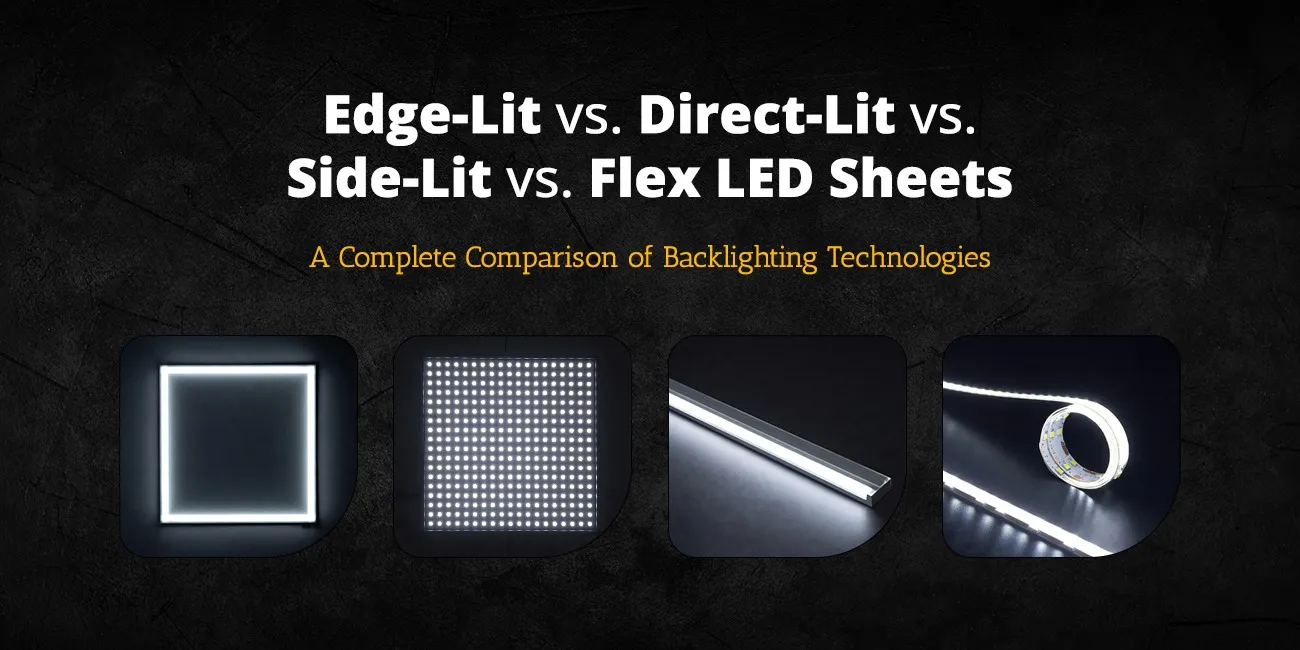
The four ways to backlight a sign — and why they’re not interchangeable
Sign manufacturers, SEG fabricators, OEM display builders, and retail brands all face the same first decision on every backlit project: which LED illumination method actually fits the application? The wrong choice doesn’t just cost extra dollars — it adds inches of cabinet depth, traps heat, creates hotspots, or makes installation a two-person job that should have taken one.
There are four mainstream backlighting technologies in use today:
- Edge-lit light guide panels (LGPs) — LEDs along the edges, light “guided” across an acrylic panel
- Direct-lit backlighting — LEDs mounted behind the graphic, shining forward through a diffuser
- Side-lit SEG frames — LEDs inside the frame channel, illuminating tension-fabric graphics
- Flex LED sheets — flexible LED tiles that backlight large or irregular surfaces
Here’s what every one of them does well, where each one fails, and how to choose between them.
1. Edge-lit light guide panels — the ultra-slim winner
Edge-lit LED light guide panels hold one competitive edge that no other backlit technology can match: they are ultra-slim.
The LED strips sit along the edges of an acrylic panel. A pattern of laser-engraved micro-dots across the panel surface scatters that edge light evenly across the viewing area. The result: edge-to-edge brightness from a panel that can be as thin as 2.0mm using injection-mold technology, or 3.0mm using laser dotting. A typical production LGP runs 4.5mm to 8.0mm thick. Even with a J-channel profile added on, total thickness rarely exceeds 10mm.
Best for:
- Backlit signs and menu boards where cabinet depth is limited
- Retail and hospitality displays where the panel is the visual element
- Frameless or near-frameless installations
- Snap frames and slim light boxes
- Any application where “thin” sells the design
Trade-off: Maximum panel size is bounded by acrylic-sheet manufacturing. LIGHTPANEL produces laser-dotted LGPs from 2″ × 2″ up to 48″ × 118″. Beyond that, you move to flex sheets or tiled installations.
2. Direct-lit backlighting — bright, but bulky
Direct-lit puts the LEDs behind the graphic, pointed forward. To eliminate hotspots, a diffuser sits in front of the LED array — and that diffuser needs distance, typically a minimum of 1/2″, sometimes 1″ or more.
That depth requirement is the whole story:
- The light box gets thicker
- The diffuser needs a mechanical structure to hold it in place
- Installation gets harder
- The cabinet eats into wall space or display real estate
Direct-lit can be built four different ways:
| Method | What it is | Quality level |
|---|---|---|
| LED tapes on the back wall | Adhesive strips applied directly | Entry-level |
| Channel letter LED modules | Discrete LED nodes wired in series | Mid-range |
| LED mesh / grid / lattice | Reticular backlighting system mounted to back wall | Professional |
| Flex sheets (LightWave®) | Pre-engineered LED light sheet, taped or screwed in place | Premium |
All four still need a diffuser positioned in front. There’s no shortcut around it.
Best for:
- Very large light boxes where edge-lighting can’t reach the center
- Applications where total brightness matters more than cabinet depth
- Custom shapes where flex sheets or LED mesh make sense
Trade-off: You’re trading thinness and install simplicity for raw brightness and size flexibility.
3. Side-lit SEG frames — purpose-built for tension fabric
Side-lit is a specialized variant. It’s used almost exclusively in SEG frames — silicone edge graphics, also called tension graphics — where a printed fabric panel is stretched across an aluminum frame.
In a side-lit SEG frame:
- LEDs are mounted inside the frame channel, pointed inward
- The fabric must have a reflective back coating
- The frame interior must have reflective back walls
- Light bounces around inside the cavity until it exits through the front fabric
Without those two reflective surfaces, the light has nowhere to swing — and the result is dim corners, dark patches, and uneven illumination.
Best for:
- Fabric-graphic SEG frames in retail, trade show, and hospitality
- Large-format soft signage where rigid panels aren’t practical
- Installations that need quick graphic-swap workflow
Trade-off: Limited to tension fabric. It’s not a general-purpose method.
4. Flex LED sheets — the LightWave® approach to large-format
LightWave® flex sheets from LIGHTPANEL’s parent brand LUXX solve a problem that none of the other three technologies handle well: seamless backlighting of very large or irregular areas.
A flex sheet is a flexible PCB studded with LEDs and pre-laminated with a diffuser. It can be:
- Cut to any shape, even on-site
- Tiled in any direction with no visible seams
- Supplied in rolls up to 30 feet long
- Powered from a single point of entry across that full 30-foot run
The LightWave® Roll It! in particular runs up to 30 feet of backlighting from a single power supply — eliminating the wiring complexity that direct-lit installations normally require. Bumpers (distance holders) make installation easy behind stones, kitchen panels, kitchen backsplashes, and bathroom installations where the flex sheet illuminates the surface from behind.
Best for:
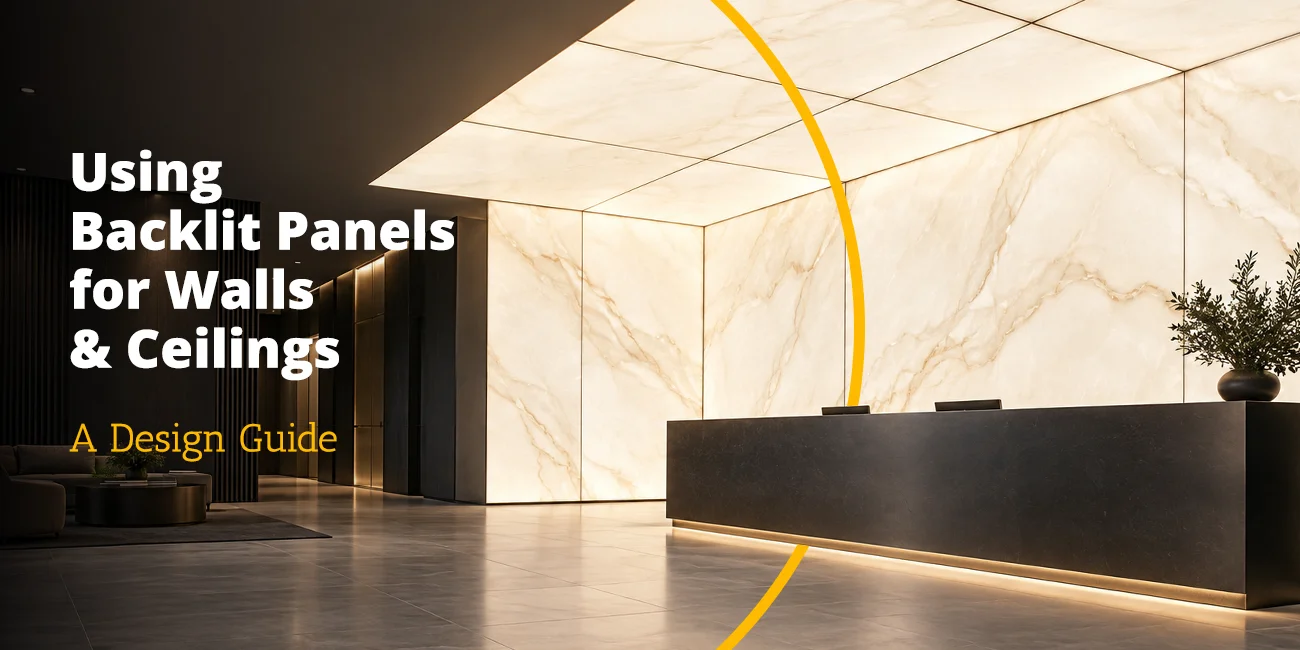
- Backlighting natural stone (onyx, marble, quartzite)
- Kitchen backsplashes and bathroom feature walls
- Architectural installations where the lit area is larger than any rigid panel
- Curved, angled, or non-rectangular shapes
- Projects where on-site cutting is required
Trade-off: Still needs a diffuser in front of the LEDs, just like any direct-lit system. Best suited for the surface-backlighting category, not slim signage.
How to choose: a one-page decision guide
| Need | Best technology |
|---|---|
| Cabinet depth under 1″ | Edge-lit LGP |
| Maximum brightness, depth doesn’t matter | Direct-lit (LED mesh or flex sheet) |
| SEG fabric graphic | Side-lit SEG frame |
| Backlight a stone wall or kitchen panel | LightWave® flex sheet |
| Backlit signage panel under 48″ × 118″ | Edge-lit LGP |
| Custom shape, on-site fitting | Flex sheet |
| Seamless area > 10 feet across | Flex sheet (tiled) |
| Snap frame or slim light box | Edge-lit LGP |
| Menu board, retail display | Edge-lit LGP |
Frame profiles add thickness — and they matter more than people think
A common mistake when comparing edge-lit panels: forgetting the profile. The acrylic panel itself might be 6mm thin, but the surrounding frame adds to the total thickness and visible footprint.
LIGHTPANEL offers two main profile types for edge-lit LGPs:
- Standard J-channel profiles add 2.0mm thickness and cover roughly 0.4″ of the panel on each side (creating a small non-illuminated border)
- L-channel profiles add only 1.0mm on the back; the front is nearly flush with the panel surface, producing a frameless look
For low-profile installations, L-channel is usually the right answer. For applications that need the J-channel’s stiffness and concealed edge, the slight border is a fair trade.
The bottom line
There is no universally “best” backlighting technology — there’s the right one for each application. Edge-lit LGPs win on thinness and uniformity for signage and displays. Direct-lit wins on raw brightness for very large boxes. Side-lit is purpose-built for SEG fabric. Flex sheets win on large, irregular, or surface-mount applications.
LIGHTPANEL specializes in edge-lit LGPs because that’s where the engineering precision matters most. For flex-sheet projects, our parent brand LUXX offers the LightWave® family. Either way, you get the right tool for the job.
Ready to spec the right backlit solution? Request a quote or download the LIGHTPANEL catalog.

Leave A Comment
You must be logged in to post a comment.