
Introduction
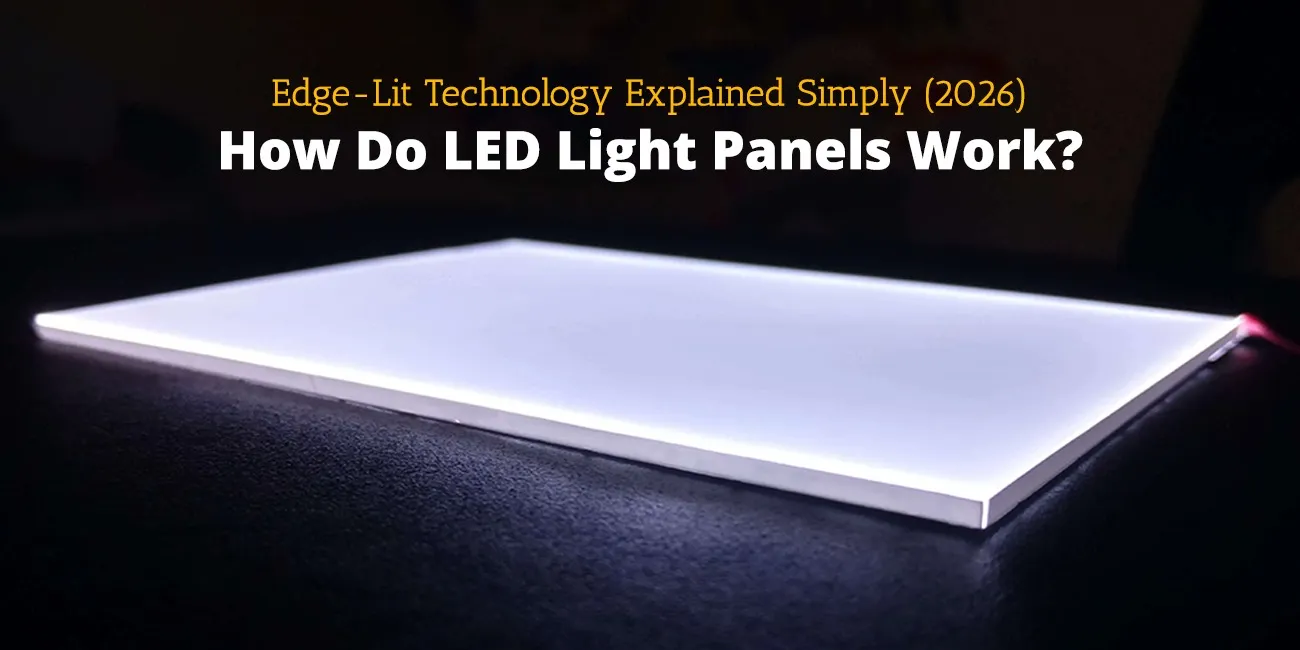
Understanding how LED Light Panels work is key to seeing why they’ve become a standard in modern lighting design.
Unlike traditional lighting that emits light directly from a bulb, these panels use edge-lit technology to guide and distribute light evenly across a surface. The result is a thin, bright panel with smooth, uniform illumination.
This guide breaks down the process in simple terms so you can clearly understand how the system works.
What Is Edge-Lit Technology?
Edge-lit technology is a lighting method where the light source is placed along the edges of a panel rather than behind it.
Instead of shining light straight outward, the system:
- pushes light into a transparent panel
- guides it across the surface
- then diffuses it evenly
This approach allows for ultra-thin lighting designs without sacrificing brightness or consistency.
Step-by-Step: How LED Light Panels Work
- Light Is Generated at the Edges:
The process begins with LED strips positioned along one or more edges of the panel. These LEDs act as the input source, injecting light into the panel instead of projecting it outward. - Light Travels Through the Panel:
Once inside, light moves through a clear panel (typically acrylic) using a principle called total internal reflection.
This means:- light bounces within the panel
- it stays trapped inside instead of escaping
- it spreads evenly across the entire surface
- Micro-Patterns Redirect the Light
The panel contains microscopic etched or printed patterns.
These patterns- control where light exits
- ensure even brightness from edge to center
- prevent bright edges and dark spots
Without this step, the panel would glow unevenly
- Diffusion Creates a Smooth Glow:
A diffuser layer sits on top of the panel.
Its job is to:
-
- soften the light
- eliminate visible points of brightness
- create a uniform, glare-free surface
This is what gives LED panels their signature clean, modern look.
Key Components of an Edge-Lit Panel System
A complete edge-lit panel includes several layers:
- Light Source (LEDs): Mounted along the edges, providing the initial light input.
- Light Guide Plate: The core panel that distributes light internally.
- Diffuser Film: Spreads light evenly across the surface.
- Reflector Layer: Redirects stray light back into the panel for efficiency.
- Optical Films (Optional): Improve brightness and directionality.
Each component works together to ensure consistent performance.
Why Edge-Lit Panels Are So Efficient
Edge-lit systems are designed to maximize output while minimizing waste.
- Efficient Light Distribution: Light is guided instead of scattered.
- Minimal Energy Loss: Reflector layers prevent wasted light.
- Thin Design: No need for bulky backlighting systems.
- Uniform Brightness: Even illumination across the entire panel.
Edge-Lit vs Backlit Panels
Understanding the difference helps clarify how edge-lit technology stands out.
Edge-Lit Panels
- Light enters from the sides
- Ultra-thin design
- Excellent uniformity
- Ideal for slim applications
Backlit Panels
- Light source sits behind the panel
- Thicker construction
- Higher brightness potential
- Used for high-output applications
Both have advantages, but edge-lit panels are preferred where design and thinness matter most.
Common Applications
Edge-lit LED panels are widely used in:
- Retail displays and shelving
- Office ceiling lighting
- Architectural wall features
- Healthcare environments
- Backlit signage
Their ability to deliver consistent, glare-free light makes them highly versatile.
Advantages of Edge-Lit Technology
- Ultra-slim profile
- Even light distribution
- Energy efficient
- Modern aesthetic
- Scalable to different sizes
Limitations to Consider
- Requires precise engineering
- Brightness may be lower than backlit systems
- Larger panels need advanced pattern design
- Custom configurations can increase cost
Why Understanding This Matters
Knowing how LED light panels work helps you:
- choose the right system for your project
- understand performance differences
- avoid poor-quality panels
- optimize design outcomes
It also highlights why edge-lit technology is widely used in premium lighting solutions.
Conclusion
LED light panels work by combining edge-lit technology, internal light distribution, and diffusion layers to create smooth, uniform illumination.
Instead of projecting light directly, they guide it across a panel and release it evenly—resulting in a thin, efficient, and visually clean lighting solution.
As lighting design continues to evolve, edge-lit systems remain one of the most effective ways to achieve both performance and aesthetics.


Leave A Comment
You must be logged in to post a comment.