
The “cloud” problem in light guide panels — and the engineering decision that eliminates it
If you’ve ever inspected a light guide panel closely and noticed faint, irregular bright or dark patches drifting across the surface — what the industry calls “clouds” — you’ve seen the result of a single manufacturing decision: whether the reflection and diffusion films were taped to the LGP or allowed to float freely.
LIGHTPANEL made that decision 25 years ago. We let the films float. Here’s the physics behind it, and why it matters every day a panel is in service.
The materials problem nobody talks about
A laser-dotted light guide panel is a sandwich of three different materials:
- The light guide itself — PMMA (acrylic)
- The reflection film behind the panel — typically PET or PC
- The diffusion film(s) in front of the panel — also typically PET or PC
PMMA, PET, and PC are three engineering plastics with three different coefficients of thermal expansion. When temperature changes — and it always changes, even in climate-controlled retail interiors — those three materials expand and contract at three different rates.
This isn’t a hypothetical. Every panel sees temperature swings:
- Switch-on heat as the LEDs warm up
- Switch-off cooldown overnight
- Daily ambient swings near a window or HVAC vent
- Seasonal shifts in unconditioned spaces
- Localized heating from sunlight, store lighting, or proximity to other equipment
Even a 10°F variation produces measurable dimensional change. Across a panel that’s 24″ or 48″ wide, those small rates of expansion translate into millimeters of differential movement between the PMMA core and the surrounding films.
What happens when the films are taped to the LGP
The intuitive engineering choice — and the one many manufacturers make — is to tape the reflection and diffusion films to the edges of the PMMA panel. It seems sensible: it locks everything in place, simplifies assembly, and prevents films from sliding around.
The problem is that the materials can’t stay locked together when temperature changes:
- The PMMA expands at one rate
- The PET reflection film expands at a different rate
- The PC diffusion film expands at a third rate
- The tape forces all three to share a common edge
Something has to give. What gives is the surface flatness of the films. They warp — bowing slightly outward in some areas, drawing inward in others, in a pattern that follows the temperature gradient across the panel.
Those warps don’t stay hidden. They show up as visible “clouds” on the lit surface — irregular bright and dark zones that drift slowly as the panel heats up or cools down. In a high-end retail display, a backlit menu, or a branded SEG installation, those clouds are immediately noticeable. They’re the kind of defect that doesn’t fail QA on day one but degrades the perceived quality of the panel for its entire service life.
What happens when the films float freely
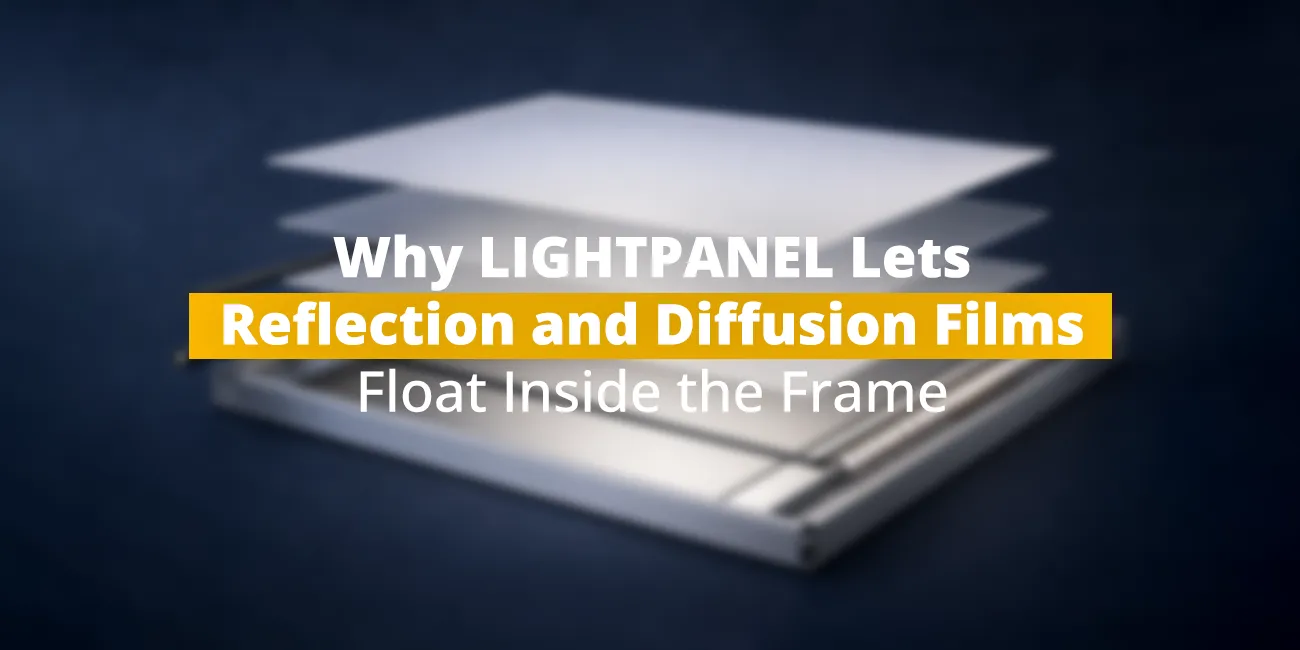
LIGHTPANEL’s solution is structural rather than material: we don’t tape the films to the PMMA. The reflection and diffusion films sit inside the surrounding aluminum profile freely, with just enough mechanical retention to keep them positioned but no rigid connection to the PMMA panel itself.
When temperature changes:
- The PMMA expands at its rate
- The PET reflection film expands at its rate, independently
- The PC diffusion film expands at its rate, independently
- Nothing forces them to share an edge
Each layer expands and contracts on its own. There’s no tension between layers. There’s no warping. There are no clouds.
This is a quiet engineering decision that doesn’t show up on a spec sheet. But it’s the difference between a panel that looks uniform on day one and stays uniform for years versus a panel that looks fine on the bench and develops visible artifacts within weeks of installation.
Why the frame matters here too
Floating films only work if there’s a frame to contain them. This is one of several reasons LIGHTPANEL uses aluminum profiles around every LGP — not just to mount the LED tape and dissipate heat, but to provide a controlled cavity where the films can move freely without falling out of position.
LIGHTPANEL stocks 80+ different aluminum profiles, including:
- L-channel profiles — adds 1.0mm on the back, near-flush front
- J-channel profiles — adds 2.0mm thickness; covers 0.4″ of LGP on each side
- SEG frames for tension fabric graphics
- Snap frames and slide-in frames for retail signage
- Magnetic cover profiles for tool-free graphic changes
Every profile is engineered to retain the LGP and the floating films at the right depth and pressure — secure enough to stay in place, loose enough to expand and contract without binding.
What this means for your finished panel
The “no clouds” engineering practice produces three measurable benefits in the field:
- Long-term uniformity. A panel that looks evenly lit on day one still looks evenly lit five years later — because the films aren’t accumulating warp damage with every thermal cycle.
- Better off-axis appearance. Cloud artifacts are most visible at oblique viewing angles. A cloud-free panel maintains its uniformity whether the viewer is looking straight on or from the side.
- Higher perceived brightness. The eye reads any non-uniformity as a brightness defect. A cloud-free surface looks brighter and more “premium” than an objectively brighter panel that has visible clouds.
For backlit menu boards, retail displays, branded SEG installations, and architectural signage — all the places where a customer sees the panel every day — these three benefits add up to the difference between a panel that looks professional and one that looks “almost right.”
A 25-year practice, not a marketing claim
Letting the films float isn’t a recent specification at LIGHTPANEL. It’s been our standard manufacturing practice since the company started in 2001. It’s the kind of detail you only learn matters by building thousands of panels and watching how they age in the field.
Combined with our laser-dotted LGP technology, optical-grade diffusion films, and matched aluminum profiles, the floating-film design is one of the reasons LIGHTPANEL panels stay uniform across years of service in retail stores, hospitality venues, transit facilities, and OEM display applications across the United States.
Specifying LGPs for a project where uniformity matters? Request a quote or download the LIGHTPANEL catalog for the full technical specifications.



Leave A Comment
You must be logged in to post a comment.