
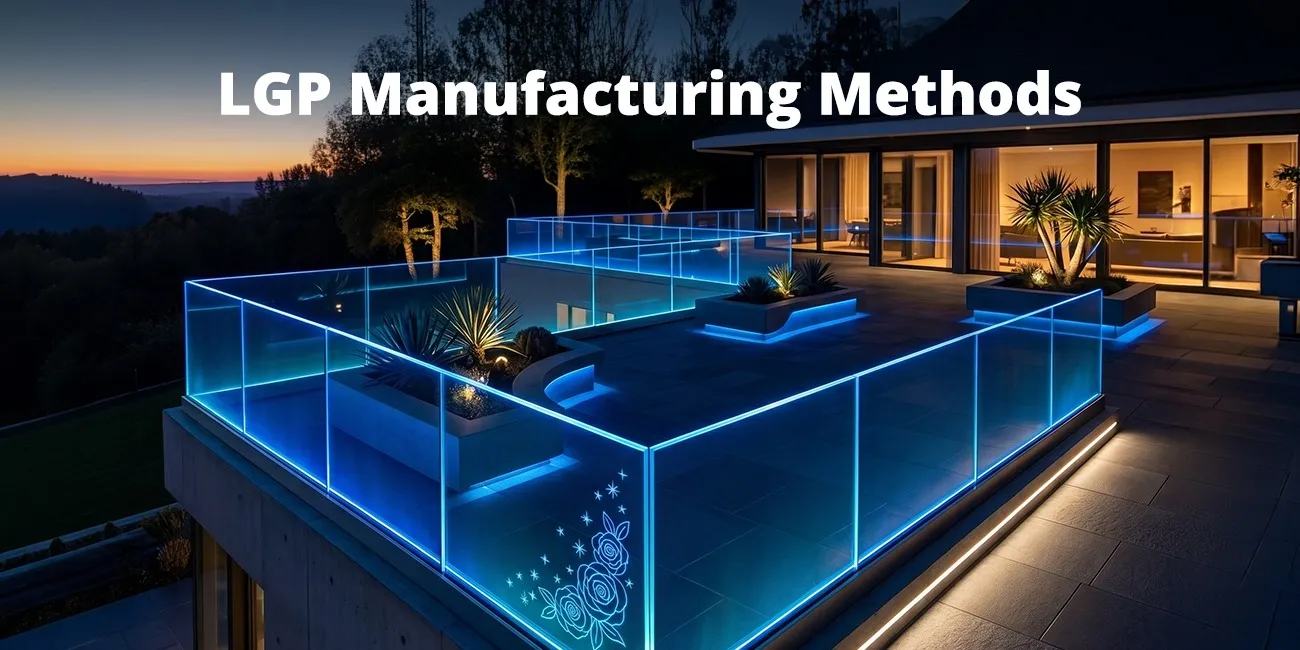
The LED tape decision that quietly defines panel quality
When you look at a finished LED light guide panel from the front, you see uniform edge-to-edge brightness. What you don’t see is the engineering decision happening at the edge of the panel: where the LED tape is mounted, and what kind of LED tape it is.
Two of LIGHTPANEL’s most important manufacturing standards live here:
- Mounting LED tapes in aluminum profiles around the LGP, not inside the acrylic itself
- Designing and manufacturing our own LED tapes specifically for use in light guide panels
Both decisions go back to 2001. Both are unusual in the industry. And both have direct, measurable effects on panel thickness, brightness, lifespan, and reliability.
Two ways to mount LED tape on an LGP
There are two architectures used in the industry for putting LED light into an edge-lit acrylic panel:
Method A — Inset: The LED tape is routed into a channel cut into the acrylic LGP itself, sitting flush within the panel.
Method B — Profile-mounted: The LED tape is mounted to a surrounding aluminum profile, sitting just outside the acrylic LGP edge.
LIGHTPANEL has used Method B since 2001. Here’s the engineering case for it.
Why profile-mounted LED tapes win on five different measurements
1. The acrylic panel can be 2mm thinner
When the LED tape is inset into the acrylic, the panel thickness has to accommodate the height of the LED strip. That adds at least 2mm to the minimum panel thickness — every time.
When the LED tape is mounted to a surrounding profile, the acrylic panel can be at its actual minimum laser-dotting thickness (3.0mm) without compromise. Total system thickness drops, and the finished panel can be thinner.
2. The aluminum profile works as a heat sink
LEDs are remarkably efficient compared to older lighting technologies, but they still produce heat — and how that heat gets away from the LED chip is the single biggest factor in determining lifespan. LEDs that run hot fail early.
When the LED tape is inset into acrylic, the only thermal path for heat is through the PMMA itself. PMMA is a thermal insulator. Heat builds up locally around each LED, accelerating wear on the chip and the phosphor coating.
When the LED tape is mounted to an aluminum profile, the entire profile becomes a continuous heat sink running the full length of the LED tape. Heat flows from the LED chip → the tape’s copper PCB → the aluminum profile → out into the surrounding air. This is exactly how LED heat management is supposed to work, and it’s a major reason LIGHTPANEL panels deliver long service life.
3. The profile adds mechanical stability to the LGP
A thin acrylic panel is fragile. Inset LED tapes weaken the edges further by removing material to create the channel. Drops, knocks, or even handling stress during installation can break corners off.
A surrounding aluminum profile mechanically reinforces every edge of the panel. It absorbs handling impacts, shipping stress, and installation torque — and the acrylic stays intact.
4. The LED tape stays in precise alignment with the panel edge
For the LGP to do its job, the LED tape has to inject light at exactly the right angle into exactly the right point on the panel edge. Even a small misalignment changes how the laser-dotted pattern scatters light — and creates visible non-uniformity.
When the LED tape is inset into a milled channel in the acrylic, there’s mechanical play. The tape can shift over time, especially with thermal cycling.
When the LED tape is mounted to the aluminum profile and the profile clamps the panel edge, the LED-to-panel alignment is mechanically fixed and stays fixed. No drift, no creep, no degradation.
5. The LED tape can’t move
Inset LED tapes rely on adhesive backing to stay in place inside the acrylic channel. As the LEDs heat and cool, that adhesive bond is stressed. Over time, especially in warm environments, the tape can lift, separate, or shift position.
Profile-mounted LED tapes are clamped against an aluminum surface that conducts heat away, so the adhesive sees less thermal stress and stays bonded longer.
The “dark edge” myth — and why L-shape profiles solve it
The argument for inset LED tapes is usually that they avoid a dark area at the edge of the panel. In practice, this advantage doesn’t exist.
When LED tape is inset into the acrylic, the tape still has to be routed a few millimeters in from the edge — there has to be acrylic between the tape and the outer edge or the panel breaks. That offset, plus the height of the LED strip itself, creates exactly the same dark zone at the edge of the lit area.
LIGHTPANEL’s L-shape profiles actually do better than inset designs at eliminating dark edges. The L-channel positions the LED tape immediately adjacent to the panel edge, with no offset, producing a nearly seamless lit area that runs all the way to the visible boundary of the panel.
Even inset-LED designs still need a mounting solution — typically a surrounding profile or frame to attach the panel to a wall or cabinet. So the inset approach gains thickness with no functional benefit and still needs the profile anyway.
80+ aluminum profiles for every application
LIGHTPANEL stocks more than 80 different aluminum profiles so the LGP and its mounting system are engineered together as one assembly. Not bolted together as an afterthought.
The lineup covers:
- L-channel profiles — adds 1.0mm on the back, near-flush front, ideal for low-profile installations
- Standard J-channel profiles — adds 2.0mm thickness; covers 0.4″ of panel on each side, gives a finished framed look
- SEG frame profiles — engineered for tension-fabric graphics
- Snap frame profiles — quick poster-change applications
- Slide-in frame profiles — clean edge-loaded graphic insertion
- Magnetic cover profiles — tool-free graphic changes
- Custom OEM profiles — application-specific for OEM display builders
Every profile is designed to dissipate heat from the LED tape, mechanically reinforce the panel, and contain the floating reflection and diffusion films at the right depth.
What makes a superior LED tape for light guide panels
Mounting the tape correctly is half the job. The LED tape itself has to be engineered specifically for LGP applications — and most aren’t. That’s why LIGHTPANEL designs and manufactures our own LED tapes rather than sourcing generic strip lighting.
Here are the nine specifications that define an LED tape built for light guide panels:
1. 2835 LEDs with two large chips per package
The 2835 LED package with twin large chips delivers higher brightness and better thermal performance than 3528 or smaller packages typically used in generic LED tape.
2. Low pitch — high LED density per meter
More LEDs per meter means smoother, more uniform light injection at the panel edge. Generic LED tape with widely-spaced LEDs creates visible bright/dim zones at the panel edge that the LGP can’t fully smooth out.
3. Ultra-high efficiency: 215 to 245 lm/W
By using LEDs binned at the highest brightness levels, LIGHTPANEL’s tapes deliver between 215 lumens per watt and 245 lumens per watt. Generic LED tape often runs at 100–150 lm/W. The efficiency difference compounds across the entire installation.
4. 6V LEDs for 25mm cutting segments at 24V DC
This one is technical but important. Standard 24V LED tape uses 3V LEDs in groups of 8 — meaning the tape can only be cut every 50mm (8 LEDs × ~6mm pitch). LIGHTPANEL uses 6V LEDs in groups of 4, cutting segments to 25mm.
The benefit: when the LED tape ends at the corner of a panel, smaller cut segments mean less non-illuminated area at the panel ends. Half the dark zone, doubled cutting flexibility. LIGHTPANEL was the first company worldwide to use 6V LEDs, custom-made for our application.
5. 4 LEDs per segment for highest efficiency
The 4-LED-per-segment architecture optimizes the electrical efficiency of each segment, minimizing resistive losses in the tape itself.
6. Strong multi-layer PCBs
Generic single-layer LED tape PCBs flex and crack under thermal cycling. LIGHTPANEL uses multi-layer PCBs that handle thermal stress without dimensional change, keeping every LED in alignment with the panel edge.
7. Solder joints engineered for reliability
The placement and sizing of solder joints is engineered for the specific thermal and mechanical environment of LGP edge-mounting. Standard reflow patterns aren’t optimal for this application.
8. Minimum tape width starting at 3.0mm
Narrower LED tape allows thinner overall panel construction. LIGHTPANEL uses tapes as narrow as 3.0mm, where most generic tape starts at 8mm or wider.
9. Lower heat generation due to high efficiency
Because the high-efficiency LEDs produce more light per watt, less of the input energy converts to heat. Combined with the aluminum profile heat sink, this is what gives LIGHTPANEL panels their long service life.
Why this matters at the project level
If the LED tape running along the edge of an LGP is generic strip lighting, the rest of the panel can’t compensate. You can have the best laser-dotting pattern, the best optical-grade diffusion film, and the best aluminum profile — and the system still underperforms because the light source feeding it is mediocre.
LIGHTPANEL’s position: the LED tape is part of the LGP, not a commodity input. That’s why we design and build it ourselves, mount it in matched aluminum profiles, and engineer every spec — chip size, pitch, voltage, segment length, PCB construction — for this application specifically.
The result is the difference between a panel that performs at its rated specs in real installations and a panel that looks fine on the bench but degrades in the field.
Specifying LGPs for a project where panel quality matters? Request a quote or download the LIGHTPANEL catalog for full LED tape and profile specifications.




Leave A Comment
You must be logged in to post a comment.