
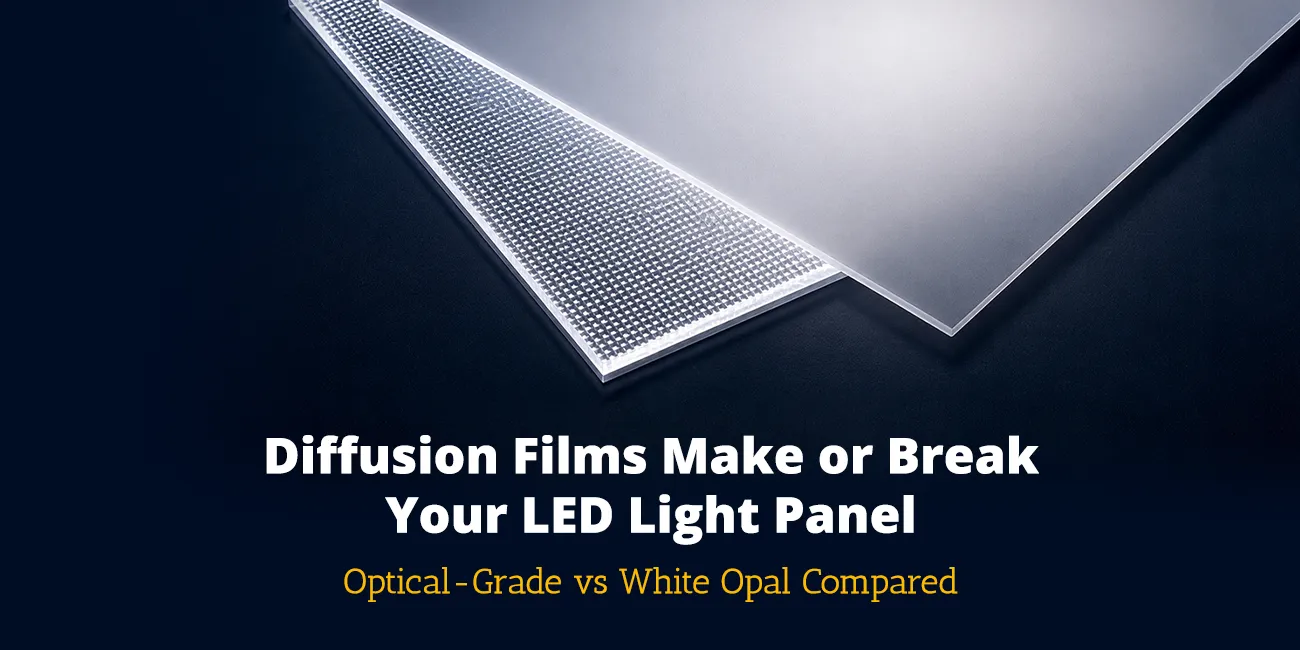
The component that decides whether your light panel hits its brightness target
When sign fabricators, SEG specifiers, and OEM integrators evaluate LED light guide panels, the conversation usually starts with LED specs — chip size, lumens per watt, color temperature. All of that matters. But there’s one component sitting in front of every LGP that quietly determines whether the panel actually delivers the brightness you paid for: the diffusion film.
The diffusion film does the final visual work. It takes the engineered light pattern from the LGP and softens it into the smooth, even glow the customer sees. Pick the wrong one — or worse, pick a diffuser that’s been cost-engineered to mask a poor LGP — and you can lose up to 60% of your panel’s brightness before any light leaves the cabinet.
Here’s how the LED light panel industry actually splits, and why LIGHTPANEL standardized on optical-grade diffusion films from the professional backlit industry.
What a diffusion film does in an LGP sandwich
A finished light guide panel is a layered assembly:
- Aluminum profile with LED tape mounted along the edges
- Reflection film behind the LGP — bounces stray light back into the panel
- Laser-dotted PMMA panel — the LGP itself, where edge light gets scattered across the surface
- Diffusion film in front — softens the light before it reaches the viewer
The diffusion film’s job is precise. It needs to:
- Spread any remaining hotspots from the LGP dot pattern into a uniform field
- Hide the dot structure itself so it’s invisible at normal viewing distance
- Transmit as much of that engineered light as possible to the front of the panel
Items 2 and 3 are in tension with item 1. A diffuser that hides the LGP dot pattern aggressively also blocks more light. The engineering challenge is finding the diffuser that hides what needs hiding while letting the maximum amount of light through.
That’s where the choice between optical-grade films and white opal sheets becomes critical.
What LIGHTPANEL uses: optical-grade diffusion films at 92–96% transparency
The professional backlit industry — the suppliers serving advertising light boxes, premium retail signage, and high-end architectural displays — has converged on optical-grade diffusion films with 92% to 96% transparency depending on thickness.
LIGHTPANEL uses these films exclusively, in three thickness tiers:
| Thickness | Transparency | Use Case |
|---|---|---|
| 0.2 mm | ~96% | Thin-profile, high-brightness applications |
| 0.4 mm | ~94% | Standard for most backlit signage |
| 1.0 mm | ~92% | Heavy-duty applications and larger panels |
Even our thickest 1.0mm optical-grade film is transmitting 92% of the LGP’s light to the front of the panel. Only 8% is lost to the diffuser.
That number matters because it’s what allows a properly engineered LGP to deliver the brightness it was designed for. The LED tape, the laser dot pattern, the reflection film — all of that work translates into actual front-of-panel brightness because the diffusion film isn’t eating it.
What other manufacturers use: 2447 white opal PC or PMMA sheets
Some companies in the LED light panel industry — particularly those competing on price — use 2447 white opal PC or PMMA sheets in place of optical-grade films. These are common, cheap, available everywhere. They’re the sheets you’d find in any plastics distributor’s catalog.
The thicknesses involved are dramatically different:
| Diffuser Type | Typical Thickness | Approximate Transparency |
|---|---|---|
| Optical-grade film | 0.2 mm to 1.0 mm | 92% to 96% |
| 2447 White Opal PC/PMMA | 2.0 mm to 4.0 mm | Often 40% or less |
A 2mm to 4mm white opal sheet can absorb or scatter back as much as 60% of the light that hits it. That’s the brightness loss number — the panel that should be delivering 3,000 nits is delivering 1,200 nits because the diffuser threw away most of the light.
Why some panels use thick white opal anyway
There’s a practical reason some manufacturers default to 2447 white opal: it covers up uneven lighting underneath.
If the LGP itself isn’t producing a uniform light field — because the dot pattern is approximate, the LED tape has gaps, or the panel was built down to a price point — a thick white opal sheet hides the defects. You can’t see the hotspots, lines, or dim zones because the diffuser has scattered everything into mush.
The trade-off is that the panel is now dramatically dimmer than it should be. The diffuser has solved the uniformity problem by sacrificing brightness. The customer ends up with a panel that looks even, but dim — and often has to drive the LEDs harder, generating more heat and shortening the panel’s lifespan, just to compensate.
LIGHTPANEL’s engineering position: fix the LGP, don’t hide it. Our laser-dotted PMMA panels produce a uniform light field on their own, so the diffusion film only has to do its real job — final softening — rather than rescuing a weak LGP. That’s why we can use a thin optical-grade film at 92–96% transparency and still deliver an even, professional surface.
How to evaluate a diffusion film when sourcing LGPs
If you’re comparing LED light panels from different suppliers, the diffusion film question is one of the fastest ways to separate engineered panels from cost-engineered ones. Three questions to ask:
- What’s the diffuser made of, and how thick is it?
- 0.2mm to 1.0mm = optical-grade film, professional backlit industry
- 2.0mm to 4.0mm = white opal sheet, brightness-reducing
- “Sandblasted PMMA” = even worse, often poor uniformity
- What’s the published transparency?
- 92% to 96% = optical-grade, standard for professional applications
- 40% to 60% = white opal, expect significant brightness loss
- Not published = ask, because it’s a meaningful spec
- How is the diffusion film mounted?
- Floating freely inside the frame = no warping, no clouds (this is our standard practice)
- Taped to the PMMA panel = will warp over time as different materials expand at different rates
A panel that scores well on all three is engineered for performance. A panel that scores poorly on any of them is engineered for cost.
What this means for your project’s brightness budget
When you’re specifying LGPs for backlit signage, SEG frames, menu boards, or retail displays, the final brightness on the customer-facing surface is what matters. That number is the product of three things:
- The light output of the LED tape
- The efficiency of the LGP at distributing that light
- The transparency of the diffusion film
Get any one of those wrong and the whole system underperforms. The diffusion film is often the cheapest place to cut cost — and the most expensive place to cut quality, because it directly multiplies (or divides) every other expense in the panel.
LIGHTPANEL’s approach: optical-grade diffusion films at 92–96% transparency, sized to the application, floated freely inside the frame so they don’t warp over time. Combined with our custom-designed LED tapes, our laser-dotted PMMA panels, and matched aluminum profiles, the result is a panel that actually delivers its specified brightness — for years, not just on day one.
Specifying LGPs for a project where brightness matters? Request a quote or download the LIGHTPANEL catalog for full optical specifications.



Leave A Comment
You must be logged in to post a comment.