
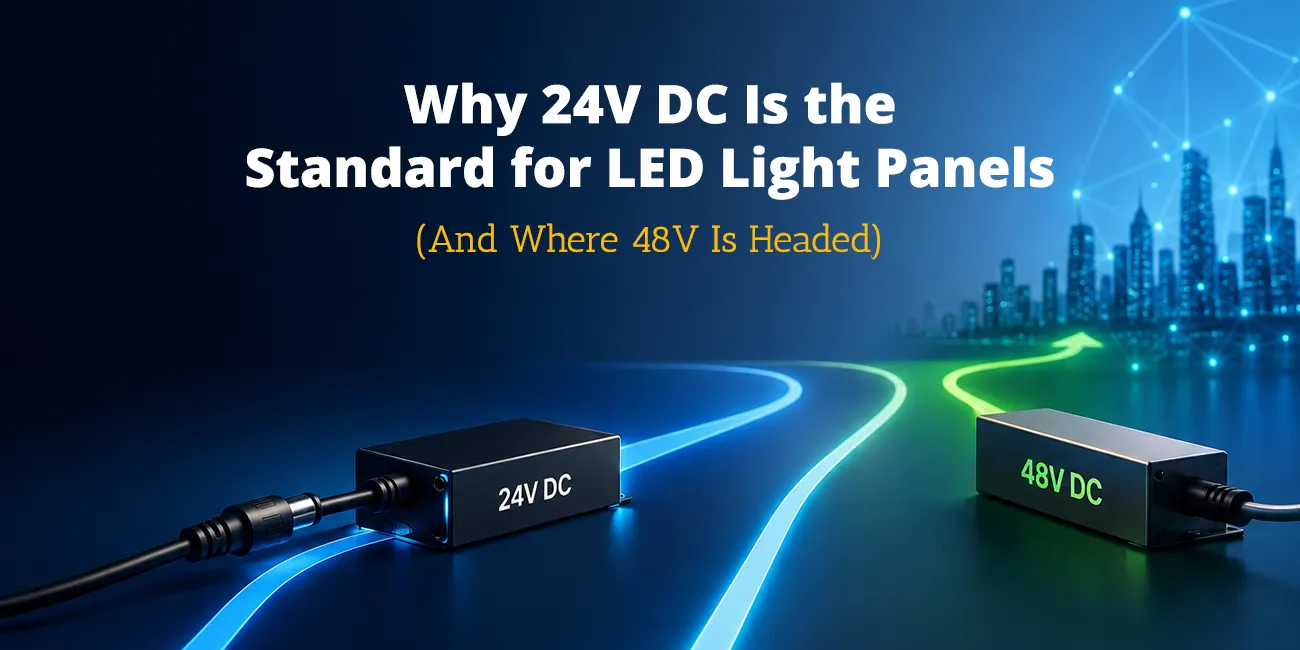
The voltage choice that quietly shapes every backlit installation
If you’ve specified LED light panels for backlit signage, SEG frames, retail displays, or menu boards, you’ve probably noticed that some manufacturers run their products at 12V DC and others at 24V DC. The difference looks cosmetic on a spec sheet. It isn’t. It changes how much LED you can run on one driver, how warm the wiring gets, and whether the brightness of your panel stays consistent end-to-end.
LIGHTPANEL standardized on 24V DC across every LED light panel we manufacture. Here are the three engineering reasons why — and where the industry is headed next.
Reason 1: UL Class 2 lets you put more LED on a single driver at 24V
UL Class 2 is the safety standard that determines whether a low-voltage LED installation is treated as a safe-extra-low-voltage system or whether it has to step up to a more restrictive (and more expensive) electrical classification.
UL Class 2 caps the output of an LED driver / power supply at the greater of 5 amps or 96 watts. That single rule changes everything depending on the system voltage:
| System voltage | Max current at UL Class 2 | Max wattage |
|---|---|---|
| 12V DC | 5 A | 60 watts (12V × 5A) |
| 24V DC | 4 A* | 96 watts (24V × 4A) |
*At 24V the wattage cap kicks in before the current cap — 96W ÷ 24V = 4A.
That’s a 60% increase in wattage per UL Class 2 driver, just by switching from 12V to 24V. In practical terms:
- A single Class 2 driver at 12V can power roughly 60W of LED
- A single Class 2 driver at 24V can power 96W of LED
- Your installation needs fewer drivers, fewer enclosures, fewer power runs, less wiring
For sign manufacturers and SEG fabricators building multi-panel installations, that’s not a small difference. It’s the difference between one power supply for a backlit wall versus three.
Reason 2: Half the current means half the heat — and a safer system
For the same power, doubling the voltage halves the current. The math is simple:
| Power | At 12V DC | At 24V DC |
|---|---|---|
| 60 W | 5.0 A | 2.5 A |
| 96 W | 8.0 A | 4.0 A |
| 120 W | 10.0 A | 5.0 A |
Lower current produces three downstream benefits:
- Cooler wiring. Wire heating goes up with the square of current (I²R). Halve the current, and resistive heating in the cabling drops by 75%. That means wires run cooler, insulation lasts longer, and there’s far less risk of thermal damage in the connector blocks where most low-voltage failures actually start.
- Smaller wire gauge. Lower current lets you use thinner gauge wire for the same load, which makes installation faster and the cabinet less crowded.
- Safer system overall. Even though both 12V and 24V are well within safe-touch limits, the lower current at 24V reduces stress on every component in the system — connectors, terminal blocks, drivers, and the LED tape itself.
This is one of the reasons LIGHTPANEL custom-designs our own LED tapes for 24V operation specifically. It’s not just about brightness — it’s about the entire thermal and electrical envelope of the installation.
Reason 3: Voltage drop becomes invisible at 24V
Every length of DC cable drops a small amount of voltage from one end to the other. For a typical AWG18 DC cable, the drop is roughly 0.1V per 4 feet of cable. Over a 40-foot run, that’s a 1V drop end-to-end.
That 1V drop means very different things depending on the system voltage:
| System Voltage | After 1V Drop | % Drop | Brightness Impact |
|---|---|---|---|
| 12V DC | 11V DC | 8.3% | Visible brightness reduction |
| 24V DC | 23V DC | 4.2% | Measurable but not visible |
| 48V DC | 47V DC | 2.1% | Negligible |
At 12V, an 8% voltage drop produces a visible brightness drop at the far end of the run. The customer sees one end of the installation brighter than the other.
At 24V, the same physical voltage drop is only 4% — and falls below the threshold the human eye can detect. You can run longer cable runs from a single power supply without daisy-chaining drivers or compensating with thicker wire.
This is why long-run installations — backlit walls, large SEG frames, multi-panel menu boards — benefit dramatically from 24V over 12V even if the per-panel wattage doesn’t strictly require it.
What’s coming next: 48V DC in Europe
Europe is already starting to shift toward 48V DC for LED installations, especially in commercial and architectural lighting. The reasoning extends every advantage of 24V over 12V one step further:
- UL Class 2 wattage cap is dictated by current, not voltage — at 48V, even more LED runs on a single driver
- Voltage drop becomes essentially negligible (~2% over 40 feet of AWG18)
- Wiring gauge can be reduced further
- Installation efficiency improves at scale
There are trade-offs at 48V — driver cost, additional safety considerations as you approach the 60V SELV ceiling, and the need for components rated to the higher voltage. For the U.S. market, 24V remains the right balance of efficiency, safety, and component availability today. But the direction of travel is clear.
For now, 24V is the right answer for backlit signage, SEG frames, light boxes, and retail display applications — and that’s what LIGHTPANEL standardizes on across the product line.
What this means when you spec a project
Three practical takeaways for sign fabricators, OEM display builders, and SEG specifiers:
- Add up your wattage and divide by 96, not 60. Sizing your power supply count assuming 12V will overcount the drivers you actually need. At 24V, one Class 2 driver covers up to 96W of LED.
- Plan cable runs around 24V tolerances. You can run longer single-feed installations at 24V before voltage drop becomes visible. Most U.S. retail and signage applications can be powered from a single point of entry per zone.
- Avoid mixing voltages. A 12V LED tape on a 24V driver will burn out fast; a 24V tape on a 12V driver will run dim. LIGHTPANEL panels and their LED tapes are matched 24V systems by design.
The LIGHTPANEL approach: matched panels, drivers, and tape
Because LIGHTPANEL designs and manufactures our own LED tapes specifically for use in light guide panels, the entire system — panel, tape, driver, profile — is engineered as one 24V DC ecosystem. That’s how we hit our published efficiency, brightness, and uniformity numbers consistently across every panel we ship.
The voltage choice is just one of many engineering details that doesn’t show up in the marketing copy but defines the actual quality of a backlit installation in the field.
Specifying LED light panels for a project? Request a quote or download the LIGHTPANEL catalog for full electrical and mechanical specs.




Leave A Comment
You must be logged in to post a comment.