
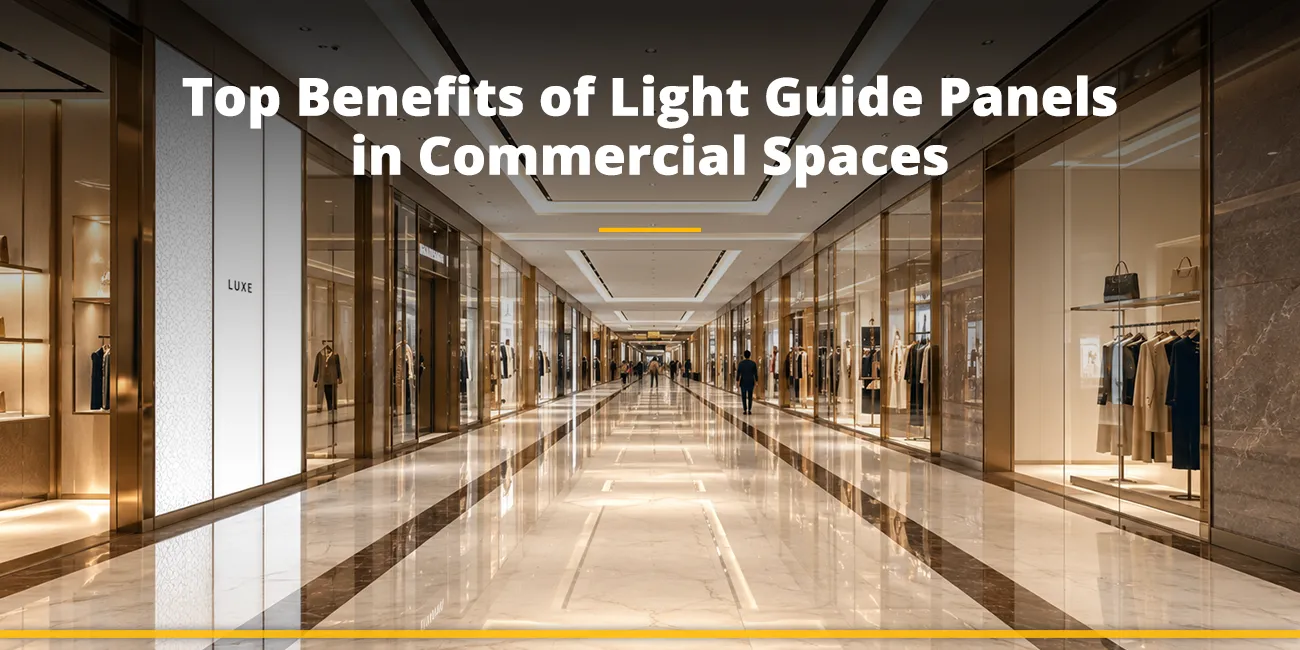
Commercial Light Guide Panels – Energy-Efficient LED Solutions for Signage & Architectural Lighting
For architects, facilities managers, and brand builders, a light guide panel (LGP) solves a problem that ordinary lighting can’t: how do you get bright, perfectly even illumination out of a fixture thin enough to disappear into the wall? In commercial spaces — retail, hospitality, healthcare, corporate lobbies, transit — that combination of thinness, uniformity, and efficiency is exactly what separates a premium environment from a cheap-looking one.
Here are the benefits that matter most when you’re specifying LGPs for a commercial project — and why they translate directly into lower cost, faster installs, and a better-looking space. (New to the technology? Start with What Is a Light Guide Panel?)
1. Ultra-thin profile reclaims space and looks premium
Because the LEDs sit along the edge of the acrylic and light is guided across the surface, an LGP needs almost no depth behind it. LIGHTPANEL panels start as thin as 2–3mm, and a complete edge-lit light box can measure under an inch deep. In a commercial fit-out, that reclaimed cabinet depth means flush wall-mounting, thinner display cases, and a clean architectural look that direct-lit fixtures simply can’t match.
2. Perfectly uniform, hotspot-free illumination
The whole point of an LGP is a laser-engraved micro-dot pattern that scatters edge light evenly across the entire surface. The payoff in a commercial setting is a display with no bright spots, no dark corners, and no visible LEDs — just a smooth wash of light behind your graphic or diffuser. For brand walls and backlit signage, that uniformity is the difference between “high-end” and “homemade.” See how it’s engineered in Engineering Uniform Illumination.
3. Energy efficiency that lowers operating cost
LGPs use low-voltage LED strips — far fewer LEDs than a direct-lit panel of the same brightness, because the light guide does the work of spreading illumination. For a commercial operator running signage 12–24 hours a day, that efficiency compounds into meaningful energy savings across dozens or hundreds of fixtures.
4. Long service life reduces maintenance
LIGHTPANEL LGPs use LEDs rated for 70,000 hours. In a commercial environment where swapping a failed fixture means a ladder, a service call, and downtime on a revenue-generating display, long life isn’t a spec-sheet nicety — it’s a direct reduction in total cost of ownership.
5. Custom sizing fits the space, not the other way around
Off-the-shelf lighting forces your design to fit the fixture. LGPs invert that. LIGHTPANEL cuts panels from 2″×2″ up to 48″×118″ in virtually any width and height, so a backlit column, an odd-shaped reception wall, or a non-standard menu run all get a panel built to the exact dimension. That flexibility is why sign shops, OEMs, and display fabricators rely on custom LGPs.
6. Design flexibility: color, temperature, and environment
Commercial spaces have different moods and requirements. LGPs adapt:
- Tunable white (CCT) from 3000K–6500K to match warm hospitality or crisp retail
- RGB / RGBW for dynamic, color-changing brand moments
- Outdoor / weatherproof panels for exterior signage and window displays
- Fire-rated panels for transit, healthcare, and high-occupancy public spaces
Where commercial LGPs make the biggest impact
The bottom line for specifiers
A light guide panel is the right call in commercial spaces whenever you need bright, even light in a thin, reliable, custom-fit package. It costs less to run, lasts longer, installs cleaner, and looks more premium than the direct-lit alternatives — which is exactly why it’s become the standard for professional backlit signage and displays.
Faster installs and lower total cost of ownership
Beyond how they look, LGPs win on the numbers that facilities and procurement teams actually track. Because a finished edge-lit box can be under an inch deep, installers avoid building out cabinet structure, which shortens labor time and simplifies mounting on existing walls. The low-voltage LED system means safer, simpler wiring than line-voltage fixtures. And with panels rated for 70,000 hours, the fixture typically outlasts several graphic changes before it ever needs service — so the up-front spec pays back across the fixture’s life, not just on day one. For multi-site rollouts, that predictability is often worth more than a lower sticker price on a lesser fixture.
For teams standardizing across many locations, custom sizing also removes a hidden cost: you stop redesigning displays around whatever stock fixture size was available, and instead get panels built to your template. That consistency protects the brand look from store to store.
Frequently asked questions
What is a light guide panel used for in commercial spaces?
Backlit signage, menu boards, retail brand walls, illuminated displays, SEG fabric frames, and architectural lighting features — anywhere a thin, evenly lit surface is needed.
Are light guide panels energy efficient?
Yes. Because the light guide spreads edge-injected light across the whole surface, LGPs need fewer LEDs than direct-lit panels of comparable brightness, lowering power draw and operating cost.
How long do commercial light guide panels last?
LIGHTPANEL LGPs use LEDs rated for 70,000 hours and carry a 2-year warranty, minimizing maintenance in high-uptime commercial installations.
Specifying LGPs for a project? Request a quote or download the catalog for sizes, specs, and lead times.

Leave A Comment
You must be logged in to post a comment.