
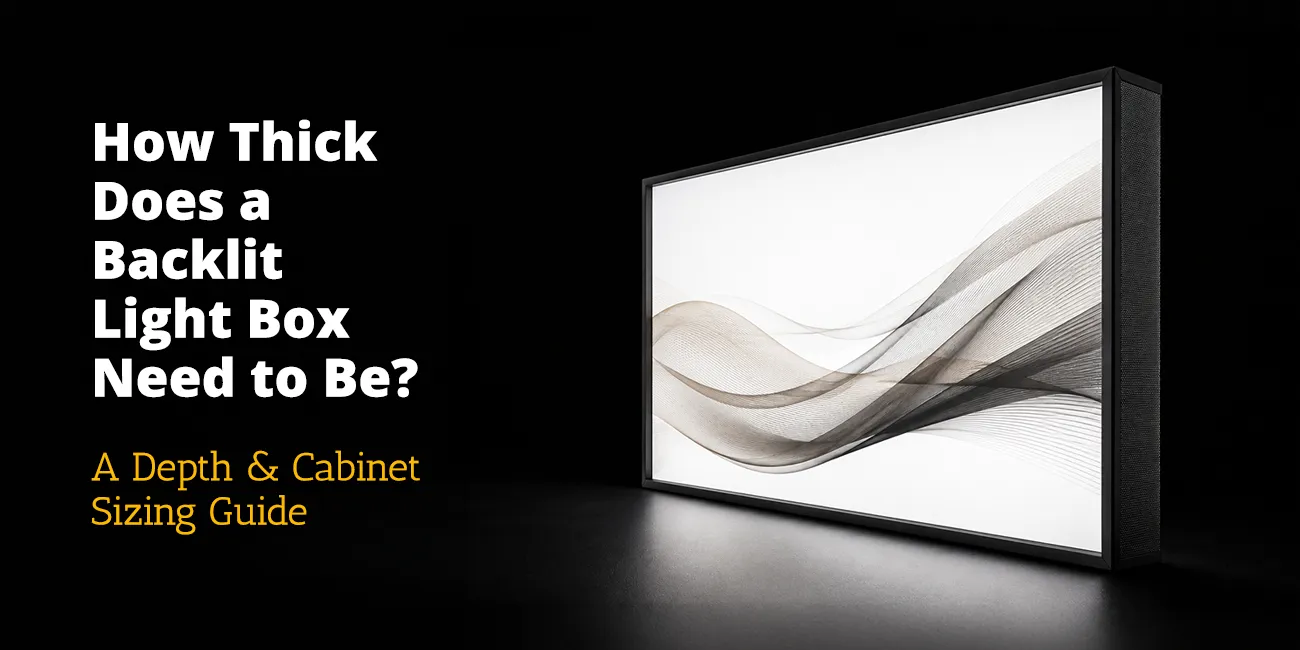
How Thick Does a Backlit Light Box Need to Be? A Depth & Cabinet Sizing Guide
It’s the question that quietly decides your whole project: how deep does the light box actually need to be? Get it wrong and you either eat inches of wall space you didn’t have, or you starve a direct-lit box of the diffusion distance it needs and end up with hotspots. The honest answer is that depth is driven almost entirely by one choice — edge-lit vs. direct-lit — and once you’ve made that call, the numbers are surprisingly predictable.
This guide gives you the real depth ranges, why they exist, and how to spec cabinet depth with confidence. (For a full method comparison, see Edge-Lit vs. Direct-Lit vs. Side-Lit vs. Flex LED Sheets.)
The one factor that sets depth: how the LEDs are arranged
Every backlit light box is either edge-lit or direct-lit, and that single difference drives thickness:
- Edge-lit — LEDs sit along the edges of an acrylic light guide panel; a laser-etched dot pattern spreads the light sideways and out the face. No depth needed behind the panel.
- Direct-lit — LEDs sit behind the graphic pointing forward; a diffuser must sit a set distance in front of them to blend the individual points into even light. That distance IS the depth.
Edge-lit light box depth: under an inch
Because an edge-lit light guide panel does its work within the acrylic itself, the finished box is remarkably thin. Real LIGHTPANEL numbers:
For most signage, menu boards, and retail displays, an edge-lit box under 1″ deep is not only possible — it’s standard. That’s why edge-lit is the default when wall clearance or a slim look matters.
Direct-lit light box depth: it scales with size
Direct-lit boxes trade thinness for raw brightness and unlimited size. But the diffuser needs breathing room. Mount it too close to the LEDs and you see every diode as a bright dot; give it enough distance and the light blends smooth. How much distance depends on the box: a small, low-output panel may need only about ½″ to 1″, while a large or high-brightness box commonly needs 3″ to 4″ or more. The bigger and brighter the box, the wider the LED spacing and the deeper the gap required to hide it.
The deeper the box, the more even the light, but the more wall space and structure it demands. There’s no shortcut around the diffuser gap in a direct-lit design — it’s physics, not a spec you can value-engineer away.
Depth decision guide
Three questions to size your cabinet
- How much depth do you have? Under ~1″ available → edge-lit is your only realistic option.
- How big is the graphic? Within 48″×118″ → edge-lit panel covers it; larger → consider direct-lit or flex.
- Brightness vs. slimness? Maximum brightness at any depth → direct-lit; thin and uniform → edge-lit.
Why edge-lit wins most signage projects
For the vast majority of backlit signs, menu boards, retail displays, and brand walls, edge-lit light guide panels deliver the brightness and uniformity you need at a fraction of the depth — under 1″ versus up to 3–4″ on large direct-lit boxes. You reclaim wall space, get a cleaner install, and avoid the hotspot risk of an under-gapped direct-lit box. Direct-lit earns its depth only when the box is very large or brightness outranks every other consideration.
Don’t forget the frame profile in your measurement
A common sizing mistake is measuring only the panel and forgetting the frame. The acrylic might be 6mm, but the surrounding profile adds to the total and creates the visible border. LIGHTPANEL offers two profiles: a J-channel that adds about 2.0mm and covers a small border on each side for stiffness, and an L-channel that adds only about 1.0mm on the back for a near-flush, frameless look. When your wall opening or recess is tight, spec the profile before you finalize the cutout — it’s the difference between a flush fit and a panel that stands proud of the surface.
Also account for the power supply. Edge-lit low-voltage systems use a slim driver that can often mount remotely or in the wall cavity, so it rarely adds to the box depth — another reason edge-lit stays thin end to end. On direct-lit boxes, plan space for both the diffuser gap and the driver.
Frequently asked questions
How thin can a backlit light box be?
With edge-lit light guide panel technology, as thin as .38″ (LIGHTPANEL snap frames). SEG frames are .61″. Bare panels can be just 2–3 mm.
Why do direct-lit light boxes need to be so deep?
The diffuser must sit a minimum distance — typically 2″ or more — in front of the LEDs to blend individual points into even light. Too little gap creates visible hotspots.
What’s the minimum depth for a direct-lit light box?
It scales with box size: roughly ½″ to 1″ for small, low-output boxes, and commonly 3″ to 4″ or more for large or high-brightness boxes, to achieve even diffusion.
Which is thinner, edge-lit or direct-lit?
Edge-lit, by a wide margin — under 1″ versus up to 3–4″ for a large direct-lit box.
Need a light box built to an exact depth? Request a quote or download the catalog for full dimensions and specs.
About the author
Andreas Weyer — Managing Partner, LIGHTPANEL
Andreas Weyer is Managing Partner of LIGHTPANEL, a brand of LUXX Light + Retail Technology (USA) Inc. LIGHTPANEL designs and manufactures custom edge-lit LED light guide panels, SEG frames, and snap-frame light boxes in North Carolina, with 30+ years of in-house optical engineering and 70,000-hour-rated LED systems. All specifications in this article reflect current LIGHTPANEL production capabilities.
Reviewed for technical accuracy against live product specifications. Last updated: July 2026.
Frequently Asked Questions
How thin can a backlit light box be?
Using edge-lit Light Guide Panel (LGP) technology, backlit light boxes can be as thin as
0.38 inches (10 mm) for snap frames and
0.61 inches (15.5 mm) for SEG fabric frames.
The light guide panel itself is typically only
2–3 mm thick, making it one of the slimmest commercial lighting solutions available.
Why do direct-lit light boxes need to be so deep?
Direct-lit light boxes require enough space between the LEDs and the diffuser so the individual LED points
blend into a smooth, uniform light. The larger the display, the greater this distance must be.
Small light boxes may only require about
0.5–1 inch of depth, while larger commercial displays often need
3–4 inches or more to eliminate visible hotspots and achieve even illumination.
What is the minimum depth for a direct-lit light box?
The minimum depth depends on the overall size and brightness requirements of the light box.
Smaller, low-output units can sometimes be built at around
0.5–1 inch deep, whereas larger or high-brightness commercial light boxes typically require
3–4 inches or more to maintain consistent lighting quality without hotspots.

Leave A Comment
You must be logged in to post a comment.