
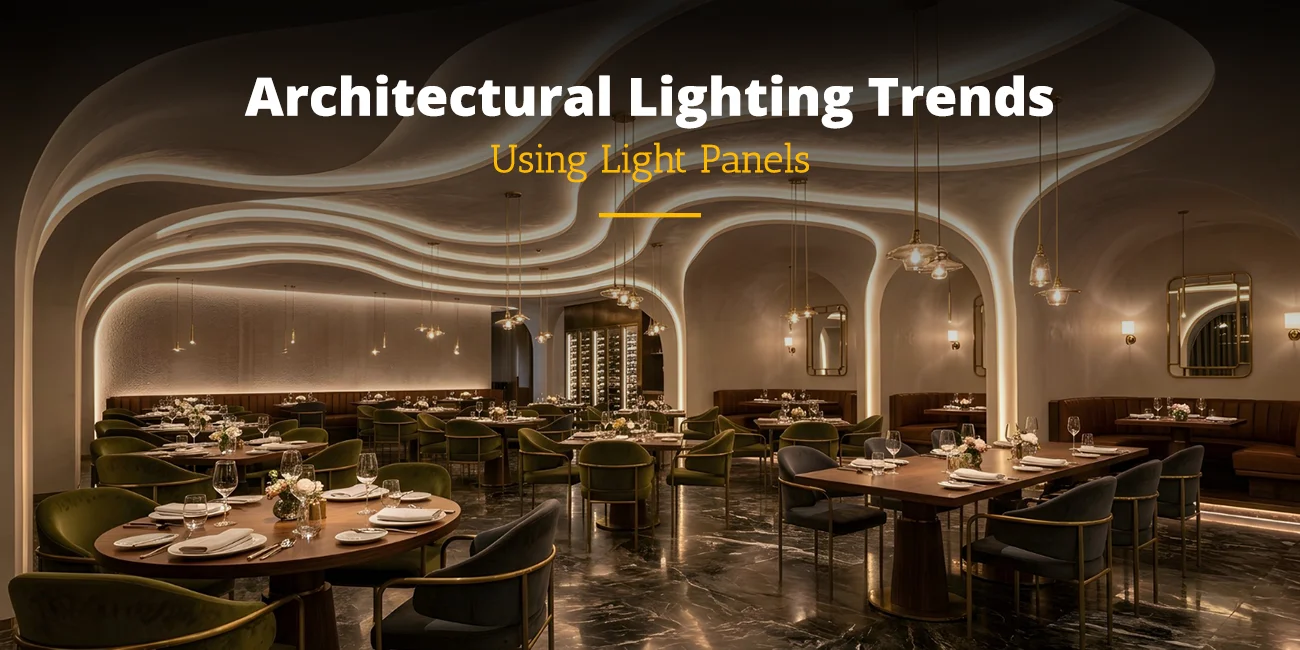
Walk into a new hotel lobby, flagship store, or Class-A office building in 2026 and there’s a good chance the most striking element in the room isn’t a fixture at all. It’s a surface. A wall that glows evenly from corner to corner. A ceiling that reads like a skylight at midnight. A reception desk with an illuminated face and no visible bulb anywhere.
Why Architectural Light Panels Are Everywhere in 2026
Three forces converged to push architectural light panels into the mainstream:
1. The “”fixture-less”” aesthetic won. Design language across hospitality, retail, healthcare, and workplace projects keeps moving toward clean planes and hidden light sources. A light panel delivers illumination as a surface rather than a point source — no glare bombs, no visible diodes, no hot spots. The technology that makes this possible is the light guide panel (LGP): a precision-patterned acrylic sheet that takes edge-mounted LED light and redistributes it evenly across the entire face.
2. Thin profiles opened new locations. LightPanel lists rigid light-guide materials in roughly the 4.5–9mm range, before the diffuser, frame, face material, and mounting details are added. That shallow light source can integrate into millwork, wall assemblies, ceiling details, and furniture where a deeper direct-lit cavity may not fit. For a full breakdown of how the illumination methods differ, see this comparison of edge-lit, direct-lit, side-lit, and flexible LED-sheet technologies.
3. Low-voltage systems made coordination more predictable. LightPanel systems use 24V DC at the panel, with drivers and controls selected for the load and project requirements. The company’s guide to 24V DC LED light panels explains the electrical architecture. The driver location, wiring method, controls, and any required listings still need to be coordinated with the project electrical engineer and authority having jurisdiction.
Trend 1: Luminous Walls as the New Feature Wall
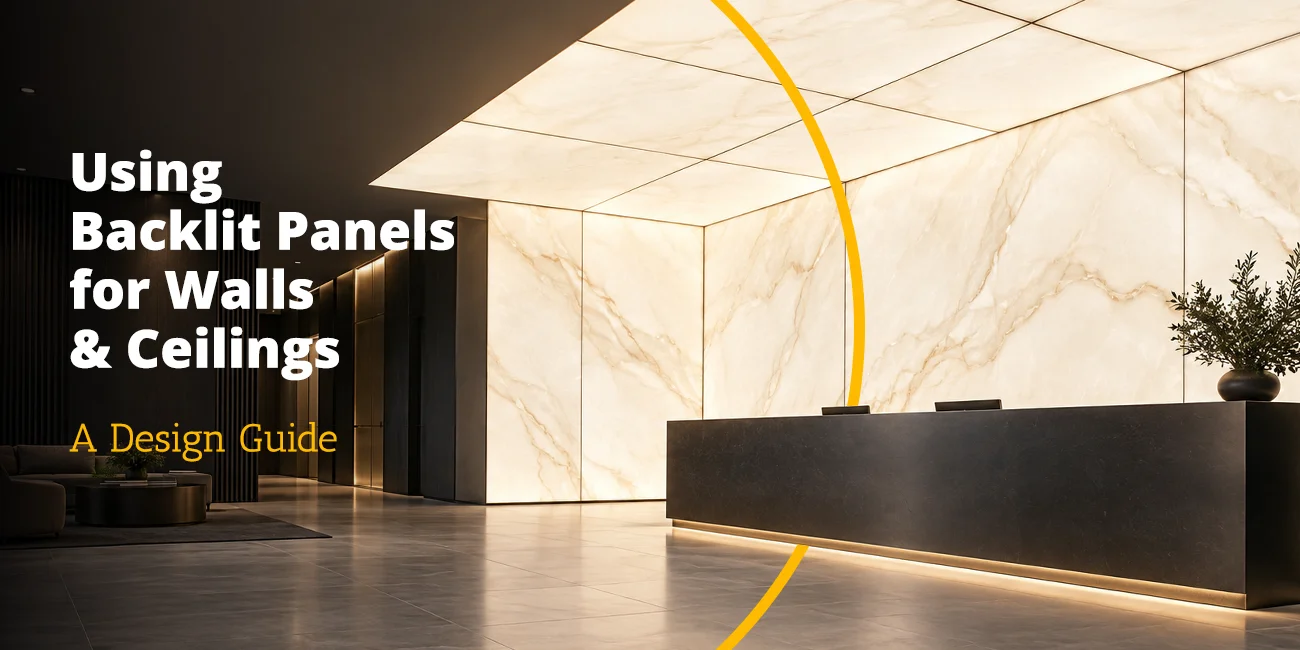
The accent wall of the 2010s was paint or reclaimed wood. In 2026, it glows. Designers are specifying full-height illuminated planes in lobbies, elevator banks, corridors, and stairwells — sometimes as pure white light, sometimes diffusing a printed graphic or translucent stone veneer from behind.
What changed is uniformity. Early attempts at glowing walls suffered from visible LED striping and “”clouds”” of uneven brightness. Modern panels solve this with digitally engineered dot patterns and optical-grade diffusion — the engineering behind that is covered in depth in this comparison of optical-grade and white opal diffusion films. When the pattern and diffusion are done right, a 10-foot wall reads as one seamless plane of light.
If your project calls for this application specifically, use our companion design guide to backlit panels for walls and ceilings for panel layout, mounting, controls, service access, and face-material decisions.
Trend 2: Tunable White and Circadian-Aware Surfaces
Static 4000K everywhere is over. Projects in workplace, healthcare, and hospitality increasingly specify CCT tunable white LED panels that shift from a warm 3000K in the evening to a crisp 5000–6500K during working hours. On an architectural scale, that means a luminous ceiling that tracks the sky or a wellness room wall that warms as the day winds down.
The design value is flexibility: one luminous surface can support a cooler daytime scene and a warmer evening atmosphere without changing the visible fixture. The related visual-design approach is explored in our article on LED light panels and biophilic retail design. For workplace or healthcare projects, any circadian-performance claim should be supported by the project’s lighting criteria, control sequence, and qualified design team—not color temperature alone.
Trend 3: Color-Capable Architecture (Without the Vegas Effect)
RGB used to imply an entertainment-only effect. The more versatile 2026 approach uses RGB and RGBW light panels for brand-color moments, wayfinding cues, and programmable scenes that shift by daypart or event. RGBW adds a dedicated white channel, allowing the same surface to produce functional white light as well as saturated color when the design calls for it.
Trend 4: Illuminated Materials — Glass, Stone, and Translucent Composites
One of the most visible 2026 trends is the panel disappearing entirely behind a premium material. Edge-lit glass LED light guide panels bring illumination into balustrades, partitions, and countertops with full optical clarity, while standard acrylic panels are increasingly used to backlight translucent stone veneer, resin panels, and printed interlayers. The light panel becomes invisible infrastructure; the material becomes the design.
Trend 5: Curved, Cut, and Non-Rectangular Light
Rectangles are no longer a constraint. CNC and laser cutting allow light panels in circles, ovals, arcs, logo silhouettes, and panels with interior cut-outs for outlets, fixtures, or structural penetrations — the fabrication capability is detailed on our U.S. light guide panel manufacturing page. Where the surface itself must bend, flexible LED light sheets handle curved columns, radiused corners, and sculptural forms that rigid acrylic can’t follow.
Trend 6: Code-Driven Specification — Fire Ratings and Outdoor Durability
As light panels move from decorative accents into building assemblies, code compliance moved to the front of the spec conversation. Two categories matter most in 2026:
Flame-retardant panel options may be relevant in regulated interiors. Review LightPanel’s flame-retardant LED light guide panels, then confirm the exact material, test report, assembly details, and acceptance criteria required by the project team and authority having jurisdiction.
Sealed outdoor-rated panels for exterior soffits, entry canopies, and facade elements exposed to weather — covered under outdoor and weatherproof LED light panels.
Specifying the rating up front — rather than discovering the requirement at inspection — is now standard practice on architectural projects.
Trend 7: Domestic Manufacturing and Spec-to-Ship Speed
Custom panels are easier to coordinate when the manufacturer can review dimensions, edge-lighting strategy, prototypes, and repeat-production requirements early. LightPanel’s U.S. light guide panel manufacturing capabilities support custom fabrication, while its OEM light guide panel engineering programs address repeatable integrations and multi-location programs.
How to Specify Architectural Light Panels: A Quick Checklist
- Dimensions and shape — exact panel size, any cut-outs, rectangular vs. custom contour
- Light color — fixed white (e.g., 6500K), tunable CCT (3000K–6500K), or RGB/RGBW
- Brightness target — driven by ambient light levels and viewing distance
- Environment — interior, damp, exterior, or code-restricted (fire rating)
- Mounting depth available — determines rigid panel vs. flex sheet and frame details
- Power routing — 24V DC driver location, wiring path, dimming/control protocol
- Serviceability — access panel or removable trim for long-term maintenance
Getting these seven answers into the spec early prevents nearly every field problem that shows up in architectural lighting punch lists.
Frequently Asked Questions
What are architectural light panels?
Architectural light panels are thin, edge-lit LED panels engineered to illuminate building surfaces — walls, ceilings, millwork, and facades — with uniform, glare-free light. Unlike fixtures, they act as luminous surfaces integrated directly into the architecture.
How thick are architectural LED panels?
LightPanel lists light-guide material options in roughly the 4.5–9mm range. Total installed depth is greater and depends on the LED profile, diffuser, face material, frame, wiring clearances, and mounting method.
Can architectural light panels be made in custom shapes?
Yes. Laser and CNC cutting supports circles, ovals, arcs, logo shapes, and panels with interior cut-outs. Flexible LED sheets extend illumination to curved and sculptural surfaces that rigid acrylic can’t follow.
What color options do architectural light panels offer?
Available systems include fixed 6500K white, tunable white from 3000K to 6500K, and RGB/RGBW color. Confirm color targets, controls, brightness, and face material during engineering.
Bring Light Panels Into Your Next Project
Whether the design calls for a luminous lobby wall, a tunable white ceiling, or an illuminated architectural element no one’s built before, the panel is rarely the constraint — the specification is. LightPanel engineers and manufactures custom architectural light panels in North Carolina, from single prototypes to multi-location programs. Request a quote or download the catalog to start with real specs, pricing, and lead times.

Leave A Comment
You must be logged in to post a comment.