
Quick Answer: Architectural light panels are edge-lit light guide panels used as slim, evenly lit surfaces in walls, ceilings, shelving and signage. LIGHTPANEL laser-dots custom panels from 2″ × 2″ up to 48″ × 118″, typically 4.5 to 8.0 mm thick, and pairs each panel with a matched aluminum profile. For larger or irregular surfaces, a flexible LED sheet is usually the better tool.
Architects and interior designers specify light guide panels when a surface has to glow evenly and stay slim. This guide covers where designers use them, what size limits to plan around, and when a flexible LED sheet is the better choice. If the technology is new to you, start with what a light guide panel is and how LED light panels work.
What are architectural light panels?
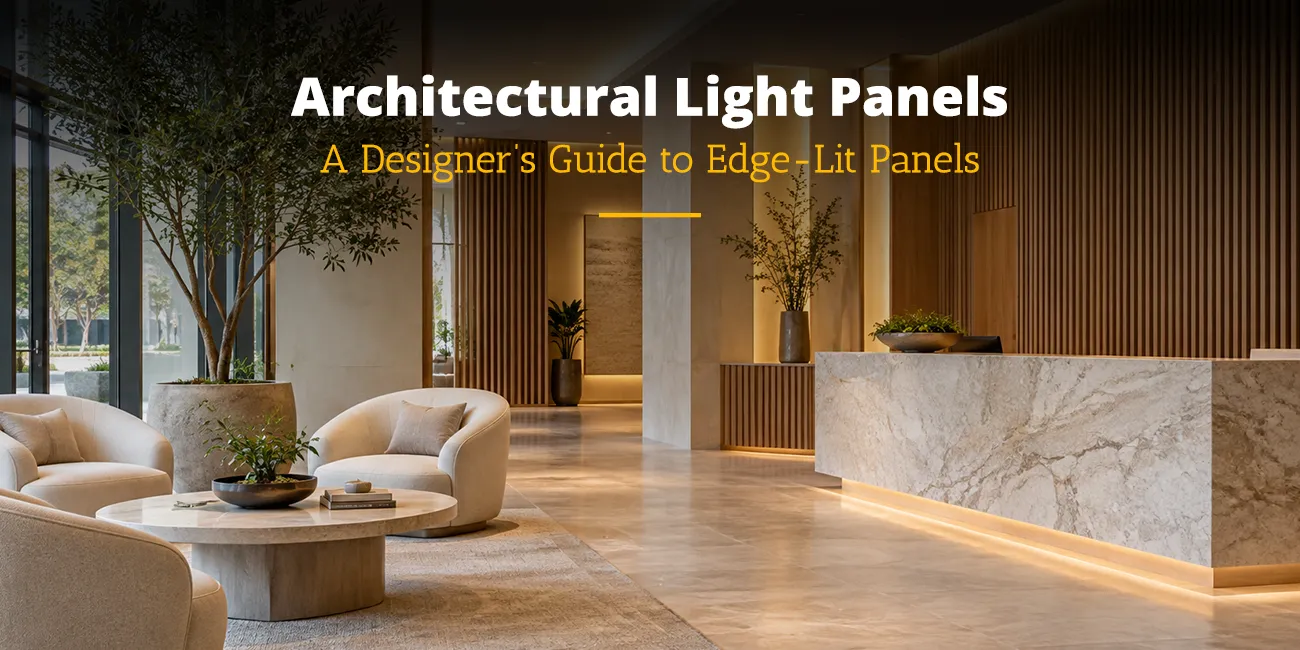
Architectural light panels are edge-lit light guide panels (LGPs) used as part of a building interior: a luminous wall detail, a ceiling field, a lit shelf or a sign. LEDs sit along the panel edge, and a laser-dotted pattern in the clear acrylic (PMMA) releases the light evenly across the face. The result is a thin surface that reads as one soft glow.
Where do designers use light guide panels in buildings?
Designers use edge-lit light guide panels wherever a slim, evenly lit surface is the design element. LIGHTPANEL panels are used in:
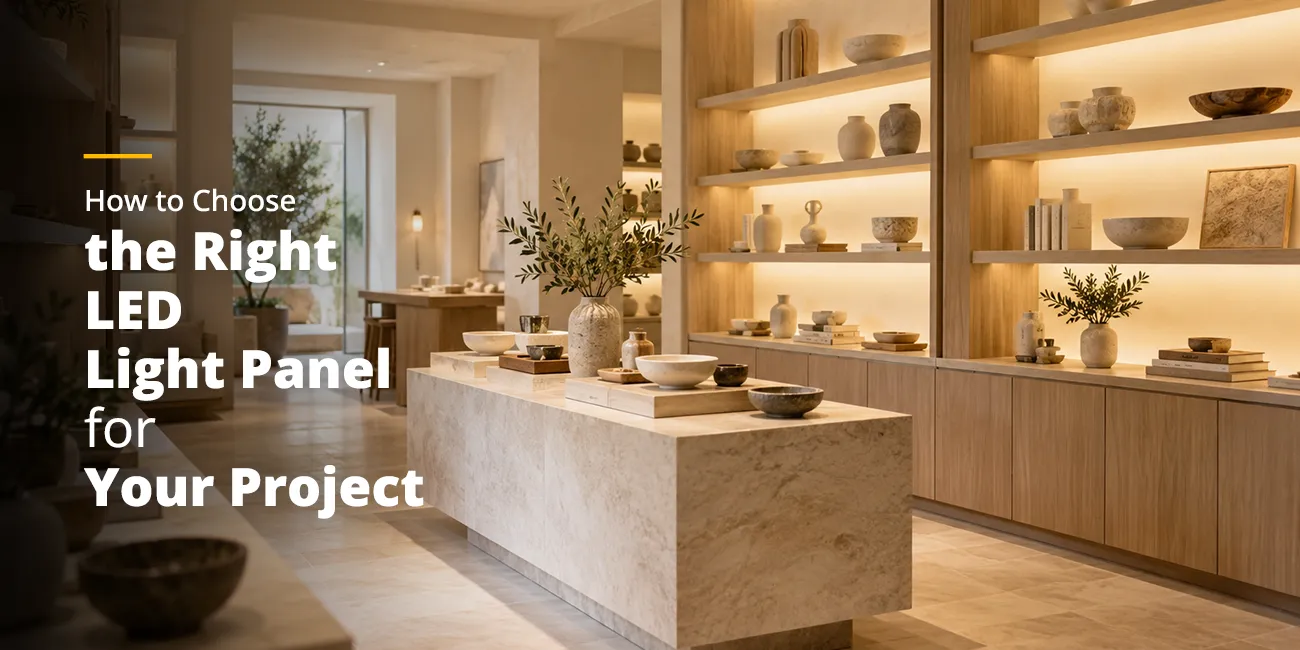
- Retail displays and illuminated shelving
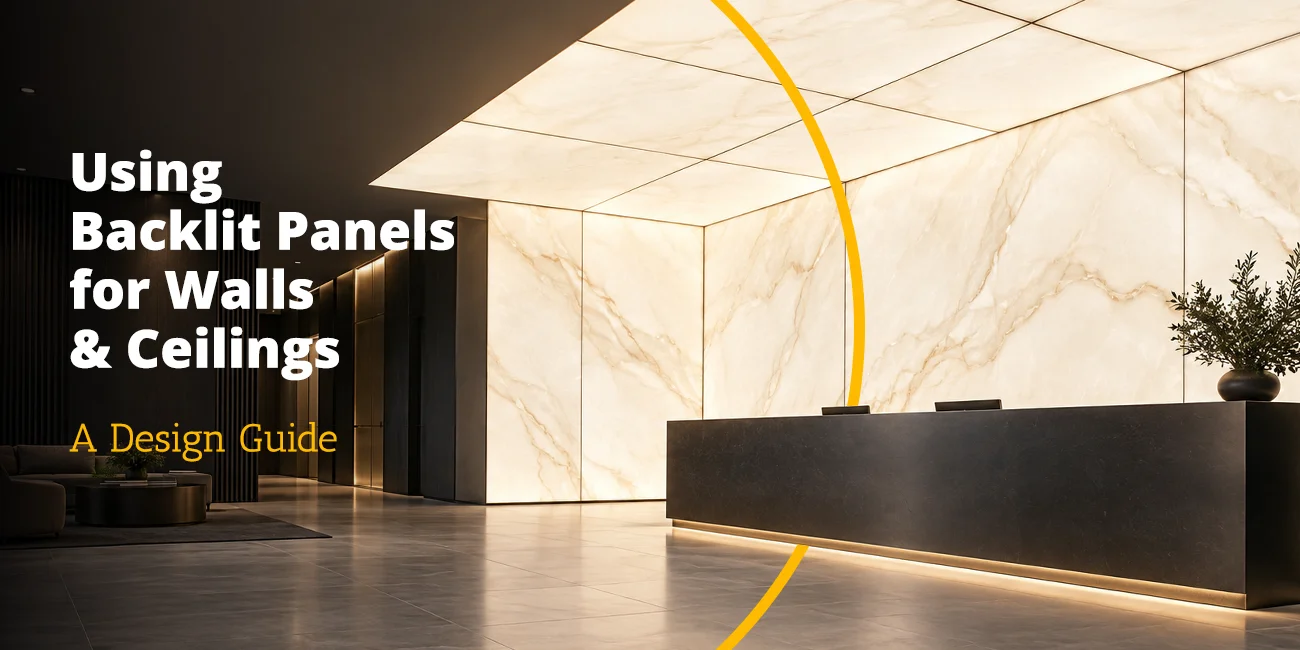
- Architectural walls and ceilings
- Healthcare environments
- Office lighting systems
- Backlit signage and menu boards
What these uses share is the need for consistent, glare-free light in a slim profile.
What size limits should you design around?
A single LIGHTPANEL laser-dotted panel can be as large as 48″ × 118″ and as small as 2″ × 2″. Each laser-dotted panel is engineered and cut to the size and LED placement your project needs.
| Detail | What to plan for |
|---|---|
| Single-panel size | 2″ × 2″ up to 48″ × 118″ |
| Custom sizes | Laser-dotted panels are cut to spec, panel by panel |
| Small standard sizes | Injection-molded, where high volume justifies the tooling |
| Typical thickness | 4.5 mm to 8.0 mm, plus the frame profile |
| Frame | Matched aluminum profile, from a range of 80+ profiles |
Panel size is bounded by acrylic-sheet manufacturing. A surface larger than
48″ × 118″ is tiled from several panels or built with a flexible LED sheet.
For frame options, see
how to choose the right LED light panel
When is a flexible LED sheet the better choice?
Choose an edge-lit panel when depth is tight and the lit surface is a defined
rectangle. Choose a flexible LED sheet when the surface is very large, curved
or irregular, or when you are lighting stone from behind.
| Project need | Better fit |
|---|---|
| Cabinet depth under 1″ | Edge-lit light guide panel |
| Snap frame or slim light box | Edge-lit light guide panel |
| Menu board or retail display | Edge-lit light guide panel |
| Custom shape fitted on site | Flexible LED sheet |
| Seamless area more than 10 ft across | Flexible LED sheet, tiled |
| Backlit stone wall or kitchen panel | Flexible LED sheet |
Panel size is bounded by acrylic-sheet manufacturing. A surface larger than 48″ × 118″ is tiled from several panels or built with a flexible LED sheet. For frame options, see how to choose the right LED light panel.
When is a flexible LED sheet the better choice?
Choose an edge-lit panel when depth is tight and the lit surface is a defined rectangle. Choose a flexible LED sheet when the surface is very large, curved or irregular, or when you are lighting stone from behind.
| Project need | Better fit |
|---|---|
| Cabinet depth under 1″ | Edge-lit light guide panel |
| Snap frame or slim light box | Edge-lit light guide panel |
| Menu board or retail display | Edge-lit light guide panel |
| Custom shape fitted on site | Flexible LED sheet |
| Seamless area more than 10 ft across | Flexible LED sheet, tiled |
| Backlit stone wall or kitchen panel | Flexible LED sheet |
Flexible sheets such as LightWave® from LUXX, LIGHTPANEL’s parent brand, are cut to shape and tiled without visible seams. They still need a diffuser in front of the LEDs. For a side-by-side look at all four lighting methods, read Edge-Lit vs. Direct-Lit vs. Side-Lit vs. Flex LED Sheets.
Frequently Asked Questions
What is the largest architectural light panel LIGHTPANEL makes?
Laser-dotted panels go up to 48″ × 118″. Larger surfaces are tiled from several panels or lit with a flexible LED sheet.
Can light guide panels be used outdoors?
Yes. LIGHTPANEL makes outdoor 24V weatherproof panels, and outdoor panels can be thicker than 10.0 mm.
Can a light guide panel be made in a custom shape?
Yes. Laser-dotted panels are cut to spec, panel by panel, so each one is engineered for its size and LED placement.
About LIGHTPANEL
LIGHTPANEL has made light guide panels since 2001 and builds them in its North Carolina facility. Specifications in this article are current as of September 2026. Check the product page and the catalog for the latest.
Planning a lit surface? Request a quote or download the LIGHTPANEL catalog.
Related reading: LED light guide panels · LED light guide panel FAQ

Leave A Comment
You must be logged in to post a comment.